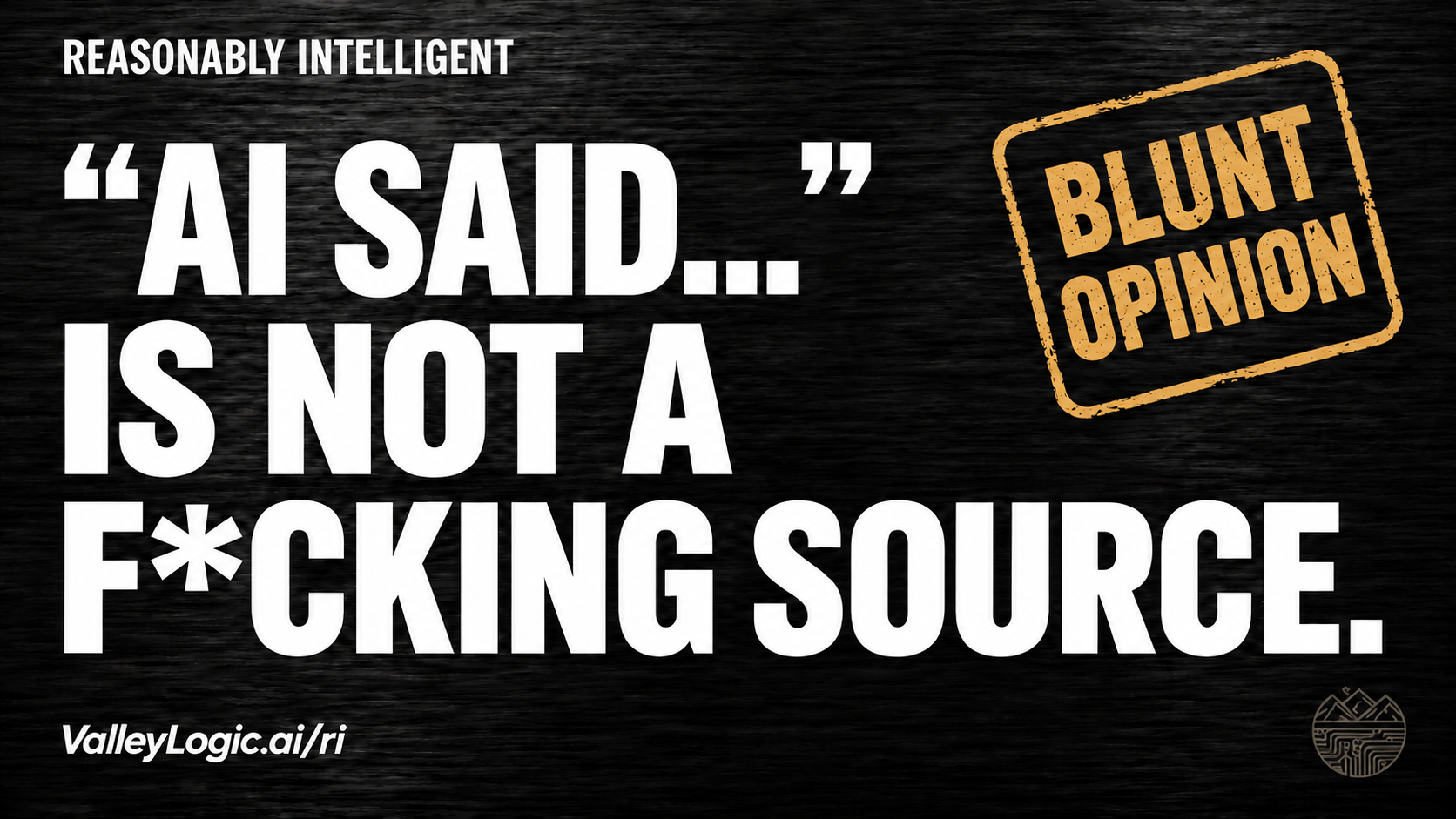
BLUNT OPINION · 5-MINUTE READ
I don’t open every source an AI gives me. I look at the URL. If I recognize a site I trust, I usually leave it there. If I don’t recognize it, I’m suspicious, but I usually don’t open that one either. Apparently, my bullshit detector has a whitelist. Sometimes I ask AI to double-check its answer for me.
I question the answer. That doesn’t mean I’ve verified it. And if I’m going to put a blunt statement about sources on a shirt, I should probably admit that before lecturing everyone else.
My position is straightforward: AI can help us investigate a claim, but its confidence is not evidence. A familiar website in the citation doesn’t finish the job. We still need to know whether the source actually supports what we’re being told.
A peer-reviewed study published at EMNLP in 2023 evaluated four AI search engines. On average, 74.5% of their citations supported the associated sentence, and 51.5% of generated sentences were fully supported by citations. Those measure different things: whether a citation backs a claim, and whether the answer provides adequate citation support. Neither is an overall factual-accuracy score. [1]
Those are historical results for the systems and queries tested. Using them as today’s error rate for every AI tool would be exactly the kind of sloppy claim this article is criticizing. They establish a narrower point: a response can have citations without having adequate support.
A 2025 Nature Communications study tested seven model configurations on 800 medical questions. Approximately 30% of individual statements from GPT-4o with web search lacked support in the cited sources. That finding concerns medical questions and the tested configuration; it does not mean 30% of all AI answers are false. An unsupported statement might be true. Its citation hasn’t established that. [2]
This is where my URL habit falls short. Recognizing the organization helps me decide where to look. It doesn’t tell me whether the AI read the page correctly, dropped a qualification, or attached the link to the wrong claim. A respected institution’s name is not a permission slip to stop reading.
Unfamiliar sources deserve the same fairness. In a peer-reviewed study of 45 people, including professional fact-checkers, historians, and Stanford students, the fact-checkers investigated sites by leaving them and consulting other sources. They reached better-supported judgments more quickly than the other groups. This was a small comparative study, not proof that every fact-checker gets everything right. It offers a useful practice: investigate credibility beyond appearances. [3]
Then there’s my other shortcut: asking AI to double-check itself. That can be useful, but what did the second check actually involve? If the original answer was bullshit, a confident reassurance can leave me with the same bullshit wearing an INSPECTED sticker. And there I am, impressed by the sticker. I still need to see what was checked.
The fair objection is that AI can help with verification. The same Nature Communications study used an AI-based source checker whose judgments agreed with a consensus of three doctors on 88.7% of 400 pairs of statements and source texts. That supports a specific checking workflow, not a guarantee about any chatbot asked ‘Are you sure?’ [2]
So I want a check I can inspect. Identify the factual claim. Open the original source. Show the relevant passage with enough context to understand it. Check the date and any limitations. Look for credible evidence against the claim, too. If access fails or the source doesn’t support the statement, say so. Don’t fill the gap with a more persuasive paragraph.
That process can still make mistakes. For consequential decisions, I want a person with the relevant knowledge reviewing the evidence. Delegating some research is useful; delegating responsibility for what I publish or recommend is where I draw the line.
I’m also not proposing that everyone turn a dinner conversation into a dissertation defense. My standard is to question answers and match the depth of checking to the consequences. A passing curiosity can remain provisional. A factual claim in a client recommendation or public article deserves a check against the original evidence before I put my name on it.
Consider a hypothetical business proposal that says an AI tool will cut administrative costs by 40%. Before repeating that number, I’d want to know who measured it, what costs they counted, and whether the work resembles ours. A study of a different task might suggest an opportunity. It doesn’t establish our savings. The percentage doesn’t become more applicable because the chatbot sounds excited about it.
And the same scrutiny applies when a claim flatters my position. I advise businesses on AI, so I have an interest in people finding it useful. I also sell a shirt with this article’s headline. Apparently, even my skepticism has a merch table. Neither gives my argument a free pass. The evidence should hold up without trusting my business card.
Better, independently evaluated verification tools would change how much manual checking I recommend for particular tasks. I should be willing to update that advice when the evidence changes. The principle would remain: confidence should track demonstrated reliability and the consequences of getting something wrong.
There is one literal exception to the shirt: if you’re studying what an AI said, its output is a primary source for that output. For a claim about the world, though, ‘AI said so’ gives us a reason to investigate, not sufficient grounds to believe it.
Use the tool. Ask the follow-up. Check what supports the answer. And when the evidence contradicts the opinion you were enjoying, change the opinion. Even if it was a really fucking satisfying opinion. The shirt can survive a little intellectual honesty.
Wear the reminder. Find the matching t-shirt and sticker in The Shop. Neither counts as a citation.
Sources
All three research sources below are peer-reviewed. The personal experiences and recommendations in the article are opinion; the study findings are attributed to their sources.
[1] Liu, N. F., Zhang, T., and Liang, P. (2023). Evaluating Verifiability in Generative Search Engines. Findings of EMNLP 2023, 7001–7025.
Read the source ↗
[2] Wu, K., et al. (2025). An automated framework for assessing how well LLMs cite relevant medical references. Nature Communications, 16, 3615. DOI: 10.1038/s41467-025-58551-6.
Read the source ↗
[3] Wineburg, S., and McGrew, S. (2019). Lateral Reading and the Nature of Expertise: Reading Less and Learning More When Evaluating Digital Information. Teachers College Record, 121(11), 1–40. DOI: 10.1177/016146811912101102.
Read the source ↗